Avicenna Journal of Clinical Microbiology and Infection. 12(3):163-165.
doi: 10.34172/ajcmi.3652
Brief Report
Eighteen-month Stability of Myoviridae Bacteriophages under Refrigeration Temperatures for Therapeutic Applications
Bahareh Lashtoo Aghaee Conceptualization, Data curation, Funding acquisition, Investigation, Methodology, Project administration, Software, Supervision, Validation, Visualization, Writing – original draft, Writing – review & editing, 1, * 
Fatemeh Dadkhah Data curation, Resources, Writing – original draft, Writing – review & editing, 2
Erfan Darban Razavi Investigation, Resources, Writing – original draft, Writing – review & editing, 2
Sima Kazemi Formal analysis, Methodology, Software, Writing – original draft, Writing – review & editing, 3
Author information:
1Department of Microbiology, Faculty of Medicine, Ramsar Campus, Mazandaran University of Medical Sciences, Ramsar, Iran
2Department of Pharmacy, Faculty of Pharmacy, Ramsar Campus, Mazandaran University of Medical Sciences, Ramsar, Iran
3Infectious Disease Research Center, Avicenna Institute of Clinical Sciences, Avicenna Health Research Institute, Hamadan University of Medical Sciences, Hamadan, Iran
Abstract
Background: Rising antimicrobial resistance, especially in Pseudomonas aeruginosa, has renewed interest in Myoviridae phages as therapeutic agents. Their long-term stability under refrigeration remains a key challenge. This study was conducted to examine the stability and therapeutic potential of three Myoviridae bacteriophages (PA45, PA32, and PA6) stored at refrigeration temperatures (approximately 4°C with minor variations) over 18 months.
Methods: The refrigerator temperature was checked weekly using a manual thermometer. Regular enrichment was performed on a monthly basis to maintain phage infectivity. Phage titers were measured using the double-layer agar method.
Results: Results indicated that jumbo phage PA32 retained over 90% of its infectivity, PA45 retained about 85%, and PA6 retained approximately 70% of its initial level.
Conclusion: These findings highlight refrigeration as a viable and practical approach for long-term phage storage, particularly in resource-limited settings.
Keywords: Refrigeration, Therapeutic, Myoviridae, Bacteriophages
Copyright and License Information
© 2025 The Author(s); Published by Hamadan University of Medical Sciences.
This is an open-access article distributed under the terms of the Creative Commons Attribution License (
https://creativecommons.org/licenses/by/4.0), which permits unrestricted use, distribution, and reproduction in any medium, provided the original work is properly cited.
Please cite this article as follows: Lashtoo Aghaee B, Dadkhah F, Darban Razavi E, Kazemi S. Eighteen-month stability of Myoviridae bacteriophages under refrigeration temperatures for therapeutic applications. Avicenna J Clin Microbiol Infect. 2025;12(3):163-165. doi:10.34172/ajcmi.3652
Introduction
Antimicrobial resistance (AMR) is a growing global health crisis, contributing to an estimated 1.27 million deaths worldwide in 2019 (1). Among resistant pathogens, Pseudomonas aeruginosa presents particular challenges due to multidrug resistance and prevalence in healthcare settings. Conventional antibiotics are increasingly ineffective against these strains, necessitating alternative treatment strategies (2). Phage therapy has emerged as a promising antibacterial strategy, using bacteriophages that specifically target pathogenic bacteria while sparing the normal human microbiota. Phages in the Myoviridae family have shown effectiveness against P. aeruginosa, but the long-term preservation of these phages is essential to maintain therapeutic efficacy (3).
Preservation strategies can significantly influence phage viability. Factors such as temperature, pH, and storage buffer all play roles in stability. Although previous studies have reported the storage of phages at various temperatures (including deep freezing and lyophilization), limited information exists on the prolonged stability of Myoviridae phages under standard refrigeration temperatures encountered in routine laboratory practice (4,5). This study investigated the stability of three Myoviridae bacteriophages stored under refrigeration temperatures (4 °C with minor fluctuations) for an extended period of 18 months, to inform practical preservation methods for phage therapy.
Materials and Methods
Phage Stocks
Three Myoviridae bacteriophages, PA6 (vB_PaeM_GUMS6), PA45 (vB_PaeM_GUMS45), and PA32 (vB_PaeM_GUMS32) (Table 1), were isolated from environmental samples, including soil and sewage, based on their lytic activity against P. aeruginosa. (6,7).
Table 1.
Characteristics of the Myoviridae Bacteriophages Used in this Study, Including Plaque Morphology and Isolation Source
|
Phage Number
|
Source of Isolation
|
Plaque Type
|
Halo Formation Around the Plaque
|
Plaque Size (mm)
|
| vB_PaeM_GUMS6 (6Soil) |
Soil |
Tiny clear |
No |
1 |
| vB_PaeM_GUMS45 (45Soil) |
Soil |
Tint clear |
No |
1.5 |
| vB_PaeM_GUMS32 (32Sewage) |
Sewage |
Clear |
No |
2 |
Phage Preparation and Enrichment
Phages were amplified using P. aeruginosa cultures in the logarithmic growth phase. Cultures were incubated in LB broth, and lysates were obtained by centrifugation at 4000 rpm for 20 minutes, followed by filtration through a 0.45 µm membrane filter. Stocks were enriched monthly by infecting fresh bacterial cultures to maintain high titers.
Purification and Storage
After enumeration, phage suspensions were further purified and stored at 4 °C. This process was repeated over an 18-month study period.
Storage Conditions
Phage suspensions were stored in a standard laboratory refrigerator at typical refrigeration temperatures (nominally 4 °C, ranging approximately from 2 to 8 °C with minor fluctuations). The refrigerator temperature was manually checked weekly using a calibrated thermometer to ensure that the temperature remained within this range.
Phage Enumeration
Phages were amplified using logarithmic-phase P. aeruginosa cultures in LB broth, followed by centrifugation at 4000 rpm for 20 minutes and filtration through a 0.45 µm membrane filter. Stocks were enriched monthly by re-infecting fresh bacterial cultures to maintain high titers. After each enrichment cycle, phage suspensions were purified and stored under refrigeration conditions.
Results
Throughout the 18-month storage period, the phages showed variable but generally high stability: PA32 retained over 90% of its initial titer, PA45 retained about 85%, and PA6 retained approximately 70% of its initial level (Table 2 and Figure 1). No significant contamination or loss of viability was observed due to the monthly enrichment strategy.
Table 2.
Phage Titer (PFU/mL) Measured at Initial, 6-Month, 12-Month, and 18-Month Time Points during Refrigeration Storage
|
Phage Name
|
Stock duration
|
|
Initial Concentration (Pfu/mL)
|
6 Months (Pfu/mL)
|
12 Months (Pfu/mL)
|
18 Months (Pfu/mL)
|
| vB_PaeM_GUMS6 (6Soil) |
3*1010 |
1*1010 |
9*109 |
7*108 |
| vB_PaeM_GUMS45 (45Soil) |
25*109 |
6*109 |
5*109 |
3*109 |
| vB_PaeM_GUMS32 (32Sewage) |
4*1010 |
2*1010 |
5*109 |
4*109 |
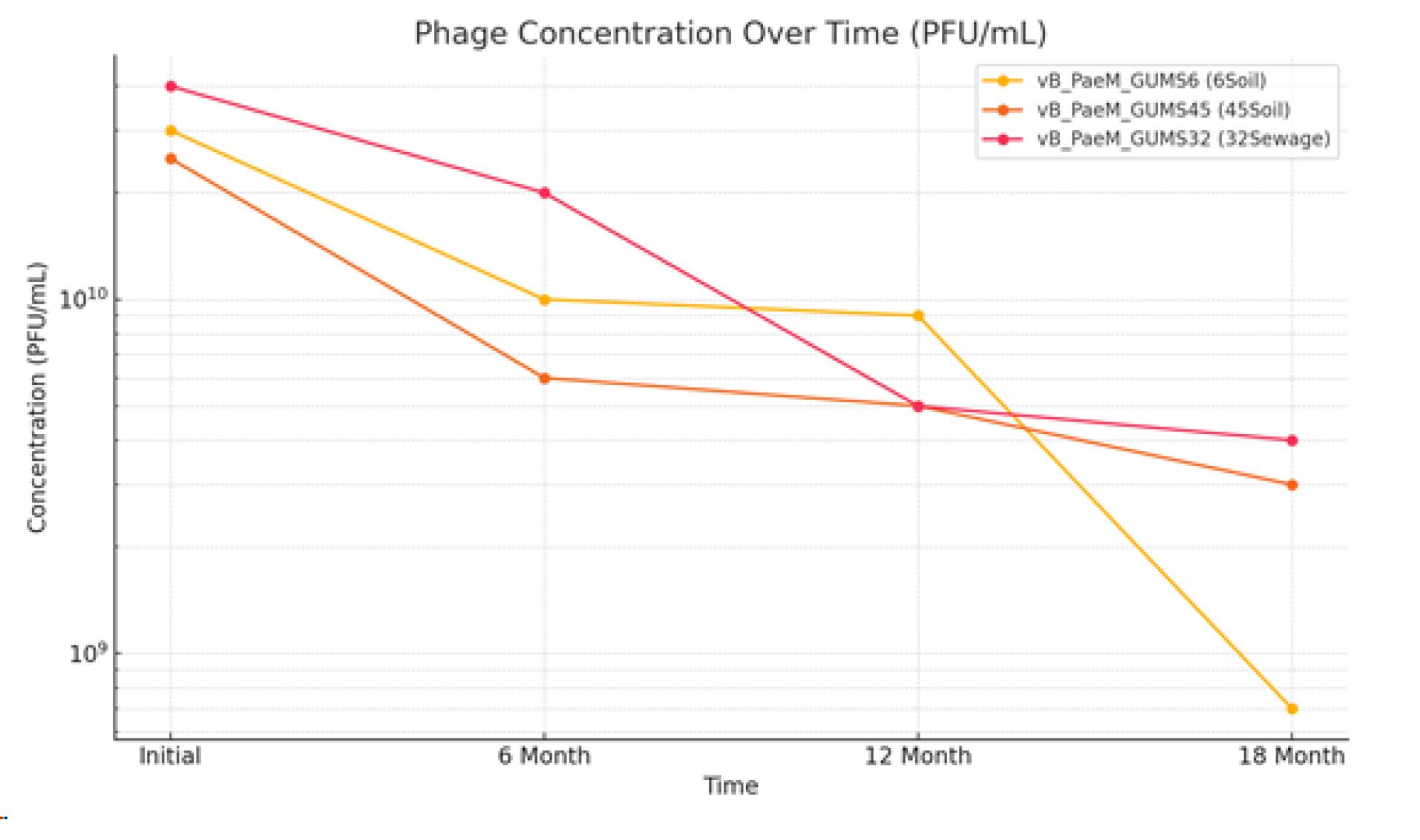
Figure 1.
Long-term Concentration Profiles (PFU/mL) of PA6, PA45, and PA32 Over an 18-Month Refrigeration Storage Period
.
Long-term Concentration Profiles (PFU/mL) of PA6, PA45, and PA32 Over an 18-Month Refrigeration Storage Period
Discussion
The growing interest in phage therapy to combat AMR underscores the importance of reliable preservation strategies. Our results confirm that refrigeration temperatures around 4°C with weekly manual checks can preserve Myoviridae phages for 18 months, comparable to earlier reports by Sarker et al (8), Tremblay et al (9) and Alvi et al (10), which showed stable phage titers over shorter durations. Unlike some studies suggesting that freezing at -20 °C or -80 °C is superior (10-12), our findings support that refrigeration, ombined with monthly enrichment, maintains infectivity without specialized equipment. Clark and Geary (13) found high titer losses at freezing, reinforcing the practicality of our approach. Furthermore, the remarkable stability of PA32 suggests capsid robustness, consistent with observations by Tremblay et al (9) about jumbo phages. However, PA6 showed a moderate decline, highlighting variability across phages, as described by Zhai et al (5). This debate suggests that while refrigeration works well for some phages, strain-specific preservation protocols remain necessary. Future research should identify molecular factors linked to long-term viability and test modern stabilizers for broader applications.
Conclusion
Refrigeration with monthly enrichment and weekly temperature checks effectively preserves the infectivity of Myoviridae phages PA45, PA32, and PA6 over at least 18 months. This approach is practical and cost-effective for maintaining phage banks intended for therapeutic use against antibiotic-resistant pathogens.
Competing Interests
The authors declare no conflict of interests.
Ethical Approval
This study was approved by Research Ethics Committees of Ramsar Campus- Mazandaran University of medical sciences(Ethic no: IR.MAZUMS.RIB.REC.1403.038).
Funding
No funding was received for this study.
References
- World Health Organization (WHO). Antimicrobial Resistance. WHO; 2024. Available from: https://www.who.int/europe/news-room/fact-sheets/item/antimicrobial-resistance.
- Pang Z, Raudonis R, Glick BR, Lin TJ, Cheng Z. Antibiotic resistance in Pseudomonas aeruginosa: mechanisms and alternative therapeutic strategies. Biotechnol Adv 2019; 37(1):177-92. doi: 10.1016/j.biotechadv.2018.11.013 [Crossref] [ Google Scholar]
- Xu Q, Hu X, Wang Y. Alternatives to conventional antibiotic therapy: potential therapeutic strategies of combating antimicrobial-resistance and biofilm-related infections. Mol Biotechnol 2021; 63(12):1103-24. doi: 10.1007/s12033-021-00371-2 [Crossref] [ Google Scholar]
- Uchiyama J, Suzuki M, Nishifuji K, Kato SI, Miyata R, Nasukawa T. Analyses of short-term antagonistic evolution of Pseudomonas aeruginosa strain PAO1 and phage KPP22 (Myoviridae family, PB1-like virus genus). Appl Environ Microbiol 2016; 82(15):4482-91. doi: 10.1128/aem.00090-16 [Crossref] [ Google Scholar]
- Zhai X, Castro-Mejía JL, Gobbi A, Aslampaloglou A, Kot W, Nielsen DS. The impact of storage buffer and storage conditions on fecal samples for bacteriophage infectivity and metavirome analyses. Microbiome 2023; 11(1):193. doi: 10.1186/s40168-023-01632-9 [Crossref] [ Google Scholar]
- Lashtoo Aghaee B, Khan Mirzaei M, Alikhani MY, Mojtahedi A, Maurice CF. Improving the inhibitory effect of phages against Pseudomonas aeruginosa isolated from a burn patient using a combination of phages and antibiotics. Viruses 2021; 13(2):334. doi: 10.3390/v13020334 [Crossref] [ Google Scholar]
- Lashtoo Aghaee B, Khan Mirzaei M, Alikhani MY, Mojtahedi A. Sewage and sewage-contaminated environments are the most prominent sources to isolate phages against Pseudomonas aeruginosa. BMC Microbiol 2021; 21(1):132. doi: 10.1186/s12866-021-02197-z [Crossref] [ Google Scholar]
- Sarker SA, Sultana S, Reuteler G, Moine D, Descombes P, Charton F. Oral phage therapy of acute bacterial diarrhea with two coliphage preparations: a randomized trial in children from Bangladesh. EBioMedicine 2016; 4:124-37. doi: 10.1016/j.ebiom.2015.12.023 [Crossref] [ Google Scholar]
- Tremblay D, Moineau S, Ackermann HW. Long-Term Bacteriophage Preservation. 2004. Available from: https://corpus.ulaval.ca/server/api/core/bitstreams/d846a0f5-b30e-461c-bec1-e3542bca0b26/content.
- Alvi IA, Asif M, Tabassum R, Abbas Z, Ur Rehman S. Storage of bacteriophages at 4°C leads to no loss in their titer after one year. Pak J Zool 2018; 50(6):2395-8. doi: 10.17582/journal.pjz/2018.50.6.sc8 [Crossref] [ Google Scholar]
- Clark WA, Klein A. The stability of bacteriophages in long term storage at liquid nitrogen temperatures. Cryobiology 1966; 3(2):68-75. doi: 10.1016/s0011-2240(66)80002-0 [Crossref] [ Google Scholar]
- Warren JC, Hatch MT. Survival of T3 coliphage in varied extracellular environments I Viability of the coliphage during storage and in aerosols. Appl Microbiol 1969; 17(2):256-61. doi: 10.1128/am.17.2.256-261.1969 [Crossref] [ Google Scholar]
- Clark WA, Geary D. Proceedings: preservation of bacteriophages by freezing and freeze-drying. Cryobiology 1973; 10(5):351-60. doi: 10.1016/0011-2240(73)90057-6 [Crossref] [ Google Scholar]