Avicenna Journal of Clinical Microbiology and Infection. 12(4):173-179.
doi: 10.34172/ajcmi.3730
Original Article
Molecular Detection and Virulence Factor Profiling of Brucella Species Isolated from Humans and Livestock in Hamadan Province, West of Iran
Behnam Rafiee Data curation, Funding acquisition, Investigation, Methodology, Resources, Software, Visualization, Writing – original draft, 1 
Masoud Ghorbanpoor Conceptualization, Formal analysis, Funding acquisition, Resources, Supervision, Validation, Writing – review & editing, 1, *
Mohammad Yousef Alikhani Conceptualization, Formal analysis, Investigation, Methodology, Project administration, Resources, Supervision, Validation, Visualization, Writing – review & editing, 2, 3, *
Leili Shokoohizadeh Data curation, Formal analysis, Investigation, Methodology, Project administration, Software, Validation, Visualization, Writing – original draft, Writing – review & editing, 2, 3
Saeed Alamian Data curation, 4
Author information:
1Department of Pathobiology, Faculty of Veterinary Medicine, Shahrekord University, Shahrekord, Iran
2Infectious Disease Research Center, Avicenna Institute of Clinical Sciences, Avicenna Health Research Institute, Hamadan University of Medical Sciences, Hamadan, Iran
3Department of Microbiology, School of Medicine, Hamadan University of Medical Sciences, Hamadan, Iran
4Razi Vaccin and Serum Research Institute(RVSRI), Agricultural Research, Education and Extension Organisation (AREEO), Karaj, Iran
Abstract
Background: Brucellosis is a prevalent zoonotic disease that impacts both humans and livestock. While most developed countries have effectively controlled this disease, it has not yet been eradicated in Iran, particularly in Hamadan Province. Accordingly, this research isolated and molecularly characterized Brucella species from humans and livestock in this province and then evaluated the presence of virulence genes in the isolates via multiplex PCR analysis.
Methods: Overall, 100 blood samples from patients suspected of brucellosis hospitalized at Sina Hospital, Hamadan, and 100 animal samples from various livestock in this province were collected from November 2021 to October 2022. The samples were subsequently cultured on specialized media, and the resulting isolates underwent both biochemical and molecular analyses. Then, a multiplex PCR assay was developed to concurrently detect the genus Brucella and distinguish between the species B. abortus and B. melitensis using primers specific to the genus and each species. The prevalence of virulence factor-associated genes in the identified species was examined by multiplex PCR. SPSS was used for data analysis, with the chi-square test employed to explore the associations between variables.
Results: In general, 61 Brucella isolates were collected, comprising 36 from humans (6 B. abortus and 30 B. melitensis) and 25 from animals (5 B. abortus and 20 B. melitensis). Approximately 83.33% of the isolates were B. melitensis, and 16.6% were B. abortus. The prevalence of virulence genes was 86.78% (znuA and bvfA), 88.52% (omp25), 81.96% (omp31), and 100% (mviN).
Conclusion: The findings suggest that brucellosis remains a significant challenge in Hamadan Province, requiring comprehensive and effective control measures. Furthermore, the high prevalence of virulence genes in isolates from this region significantly increases the pathogenic potential of the bacteria.
Keywords: Brucella, Molecular, Livestock, Multiplex PCR, Virulence genes
Copyright and License Information
© 2025 The Author(s); Published by Hamadan University of Medical Sciences.
This is an open-access article distributed under the terms of the Creative Commons Attribution License (
https://creativecommons.org/licenses/by/4.0), which permits unrestricted use, distribution, and reproduction in any medium, provided the original work is properly cited.
Please cite this article as follows: Rafiee B, Ghorbanpour M, Alikhani MY, Shokoohizadeh L, Alamian S. Molecular detection and virulence factor profiling of Brucella species isolated from humans and livestock in Hamadan province, west of Iran. Avicenna J Clin Microbiol Infect. 2025;12(4):173-179. doi:10.34172/ajcmi.3730
Introduction
The genus Brucella includes several species of Gram-negative bacteria that are responsible for brucellosis, a zoonotic disease affecting humans, livestock, and wildlife worldwide. The primary species transmitted between animals and humans are B. abortus, B. melitensis, and B. suis. In livestock, brucellosis leads to reproductive problems, such as abortions, infertility, decreased milk production, and retained placenta. In humans, it manifests as a persistent and severe illness characterized by recurring fever and other systemic symptoms (1).
Brucellosis presents a substantial challenge to public health and economies worldwide, especially in regions where eradication efforts are unsuccessful. While most developed countries control the disease through regular animal screening and vaccination, Iran remains endemic in regions such as Hamadan Province (2-4). Although traditionally regarded as a disease with low mortality, human brucellosis is the most widespread zoonosis worldwide. It is primarily transmitted through the ingestion of unpasteurized dairy products or via contact with infected animals and their secretions, especially during parturition. The bacteria are highly infectious, thereby making occupational exposure a risk (5).
The disease is caused by several Brucella species, with B. abortus, B. melitensis, B. suis, and B. canis being the main species responsible for infections in humans (2,6). The World Health Organization identifies B. melitensis as the predominant cause of human brucellosis in Iran, followed by B. abortus, which affects both humans and livestock. Although infections with B. abortus are often mild, they can lead to chronic and troublesome health issues. However, B. melitensis typically causes more acute, severe, and debilitating disease, occurring in various forms (7-9). Brucellosis mainly damages the genitourinary tract in animals. The transmission dynamics and prevalence in a region depend on multiple factors, including dairy processing methods, cultural practices, animal management, dietary habits, climate, and socio-economic and health conditions (5,10-12).
The clinical signs of brucellosis in humans and animals are non-specific, making prompt and accurate diagnosis essential. Early detection is vital for initiating treatment in humans and for managing disease control in animals (13). Bacterial isolation via culture, serological and agglutination tests (e.g., enzyme-linked immunosorbent assay), and molecular detection techniques (e.g., polymerase chain reaction [PCR] can be used for diagnosing brucellosis) (14). Culture, considered the gold standard, is less sensitive due to its long incubation period, the intracellular nature of Brucella, and challenges in isolating bacteria in chronic cases; in addition, it requires high-level biosafety laboratories. Conversely, PCR is a quick, safe, and highly sensitive and specific method that can recognize Brucella at the species level (15-18).
The pathogenicity of Brucella involves its ability to invade host epithelial cells, survive and replicate within phagocytic and non-phagocytic cells, evade opsonization, and infect macrophages. Virulence genes, such as znuA, bvfA, omp25, omp31, and mviN, are crucial for the intracellular survival of bacteria (19). The bvfA gene encodes a small periplasmic protein (~11 kDa) that is unique to Brucella. This protein plays a role in helping the bacterium establish itself within host cells (20). The omp25 protein contributes to virulence by inhibiting tumor necrosis factor-alpha release from human macrophages, while omp31 is involved in iron acquisition and storage (21,22). The znuA gene encodes a zinc uptake system essential for the intracellular replication of Brucella by chelating zinc, thereby helping it evade macrophage killing (23,24). The mviN gene, similar to its homolog in Salmonella, is also vital for Brucella pathogenicity (25).
To enhance control and prevention strategies, it is essential to rapidly and accurately identify Brucella species, thereby reducing the impact of the disease and its related complications. Given the high prevalence of brucellosis in Hamadan Province and the limited number of studies comparing the frequency and virulence of animal and human strains, this study aims to molecularly identify Brucella species isolated from both livestock and humans in Hamadan. Additionally, the research seeks to investigate the presence of key virulence factor genes in these isolates using multiplex PCR, with the goal of better understanding their pathogenic potential and supporting the development of targeted interventions.
Materials and Methods
Collecting Samples
In this study, a total of 100 blood samples were collected from patients suspected of having brucellosis at the Infectious Diseases Department of Sina Hospital in Hamadan. Additionally, 100 animal samples, including lymph nodes, abortive materials, mammary fluid, amniotic fluid, and milk from livestock (e.g., sheep, cattle, and goats), were obtained from various regions of Hamadan Province. These samples were selected based on positive serum tests and were collected between November 2021 and October 2022. The human participants were thoroughly categorized based on gender, age, education level, urban or rural residence, occupation, and clinical symptoms. Similarly, the infected livestock were classified according to demographic data, geographic location, age, and gender.
Brucella Isolation
For Brucella spp. isolation, human blood samples were transferred to suitable culture media. The study employed the BACTEC blood culture system (BD9050, USA), an automated system for microbiological growth detection. The samples were incubated for a period ranging from 7 days to 21 days at 37°C. In addition, any vials showing positive microbial growth were subsequently cultured on blood agar plates and incubated for an additional 3–7 days in a conventional incubator and a 10% CO₂ incubator. To isolate Brucella spp. from animal samples, specimens were cultured on Brucella agar medium supplemented with 5% bovine serum, dextrose, and a combination of antibiotics (i.e., cycloheximide, bacitracin, polymyxin B sulfate, vancomycin, nalidixic acid, and nystatin) and incubated for 3–7 days in both a 10% CO₂ incubator and a conventional incubator at 37°C. Bacterial cultivation was performed in a dedicated, isolated environment within a laboratory equipped with biosafety level 3. All necessary precautions were diligently observed, including the use of protective equipment to ensure the safety of the researchers.
All culture-positive samples were further subjected to biochemical testing, including urease, catalase, and oxidase assays, to confirm the presence of Brucella spp.
Molecular Detection of Brucella Species and Virulence Genes
Genomic DNA was extracted through a boiling method. A full loopful of bacterial colony was suspended in 300 μL of sterile distilled water and heated at 100°C for 15 minutes. The mixture was then centrifuged at 13,000 rpm, and the supernatant, which contained the DNA, was collected and stored at -20°C for subsequent analysis.
Following the isolation of Brucella spp., molecular identification was conducted using the PCR technique. A multiplex PCR approach was employed with primers B4-B5, which are genus-specific for Brucella, along with primers Ba-SP IS711 and Bm-SP IS711, specific for B. abortus and B. melitensis, respectively (Table 1). Subsequently, to detect the presence of virulence genes, including znuA, bvfA, omp25, omp31, and mviN, specific primers (Table 2) were used in multiplex PCR assays. All primers utilized in this study were synthesized by Metabion Company (Germany).
Table 1.
Genus-Specific and Species-Specific Primers for Brucella melitensis and Brucella abortus
|
Target Genes
|
Primer Sequences (5-3´)
|
Size
|
References
|
|
B4-B5 |
F: CGC-GCT-TGC-CTT-TCA-GGT-CTG
R: TGG-CTC-GGT-TGC-CAA-TAT-CAA |
232 bp |
(26) |
|
Meli-Is711
|
F: AAA-TCG-CGT-CCT-TGC-TGG-TCT-GA
R: TGC-CGA-TCA-CTT-AAG-GGC-CTT-CAT |
731 bp |
(27) |
|
Abor-Is711
|
F: GAC-GAA-CGG-AAT-TTT-TCC-AAT-CCC
R: TGC-CGA-TCA-CTT-AAG-GGC-CTT-CAT |
498 bp |
(27) |
Table 2.
Sequences of Primers Specific to Virulence Factor Genes in Brucella spp.
|
Target
|
Primer Sequence 5’-3’
|
Size
|
References
|
|
mviN |
F: GCA-GAT-CAA-CCT-GCT-CAT-CA
R: GCC-ATA-GAT-CGC-CAG-AAT-A |
344 bp |
(28) |
|
omp25 |
F: CGT-ACC-TCA-CGG-CTG-GTA-TT
R: CGT-ACC-GGC-CAG-ATC-ATA-GT |
188 bp |
(28) |
|
omp31 |
F: GCT-GCT-CCT-GTT-GAC-ACC-TT
R: GCT-GAA-ATC-GAA-CCC-GTA-AC |
257 bp |
(28) |
|
znuA |
F: CTG-GGT-CCG-AGC-ATG-TTT-AT
R: AGG-CAT-CGA-GTT-TTT-CTC-CA |
465 bp |
(28) |
|
bvfA |
F: CTG-GGT-CCG-AGC-ATG-TTT-AT
R: CCG-CGC-TGA-TTT-CAT-CGC-TG |
1282 bp |
(29) |
To perform the multiplex PCR test, the final mixture used in the reaction contained 2 μL of DNA in a final volume of 25 μL, including 12 μL of standard master mix (Ampliqon-Denmark) and 2 μL of primers related to the Brucella genus (1 μL forward primer and 1 μL reverse primer), 2 μL of Bm-SP Is711 primer, 2 μL of BA-SP Is711 primer, and 7 μL of sterile distilled water. The PCR cycling conditions for detecting Brucella species consisted of an initial denaturation at 95°C for 3 minutes, followed by 35 amplification cycles consisting of 90 seconds at 95°C (denaturation), 60 seconds at 58 °C (annealing), and 60 seconds at 72°C (extension). A final extension step was carried out at 72 °C for 5 minutes.
For detecting five virulence genes within the identified Brucella species, a second multiplex PCR was performed in a 25 μL reaction volume. The cycling conditions included an initial denaturation at 94 °C for 5 minutes, followed by 25 cycles consisting of 60 seconds at 94 °C, 60 seconds at 58 °C, and 60 seconds at 72 °C. The final extension was conducted at 72 °C for 10 minutes. All PCRs were performed using a Bio-Rad T100 thermocycler. B. abortus strain 544 (ATCC: 23448) and B. melitensis strain M16 (ATCC: 23456) were used as positive controls, and Escherichia coli standard strain ATCC (43895) was utilized as a negative control.
Statistical Analysis
Statistical analyses were conducted using SPSS software (version 19.8). A confidence level of 95% was applied to all tests. Eventually, the chi-square test was employed to assess associations and relationships between variables within the study data.
Results
Results of Biochemical Tests
Biochemical tests, including urease, oxidase, and catalase assays, were performed on all isolates, and all tests yielded positive results. The B. abortus strains were cultured in a CO₂ incubator set at 10% CO₂. Among the animal isolates, 5 and 20 were identified as B. abortus and B. melitensis, respectively. In contrast, from the human samples, 30 and 6 isolates were detected as B. melitensis and B. abortus.
Multiplex Polymerase Chain Reaction Results
Primers specific to the Brucella genus, as well as those targeting B. abortus and B. melitensis, were simultaneously used in the multiplex PCR test conducted in this research. The presence of a 232 bp band in the electrophoresis confirmed the Brucella genus. Additionally, a 731 bp band indicated B. melitensis, while a 498 bp band signified B. abortus (Figure 1).
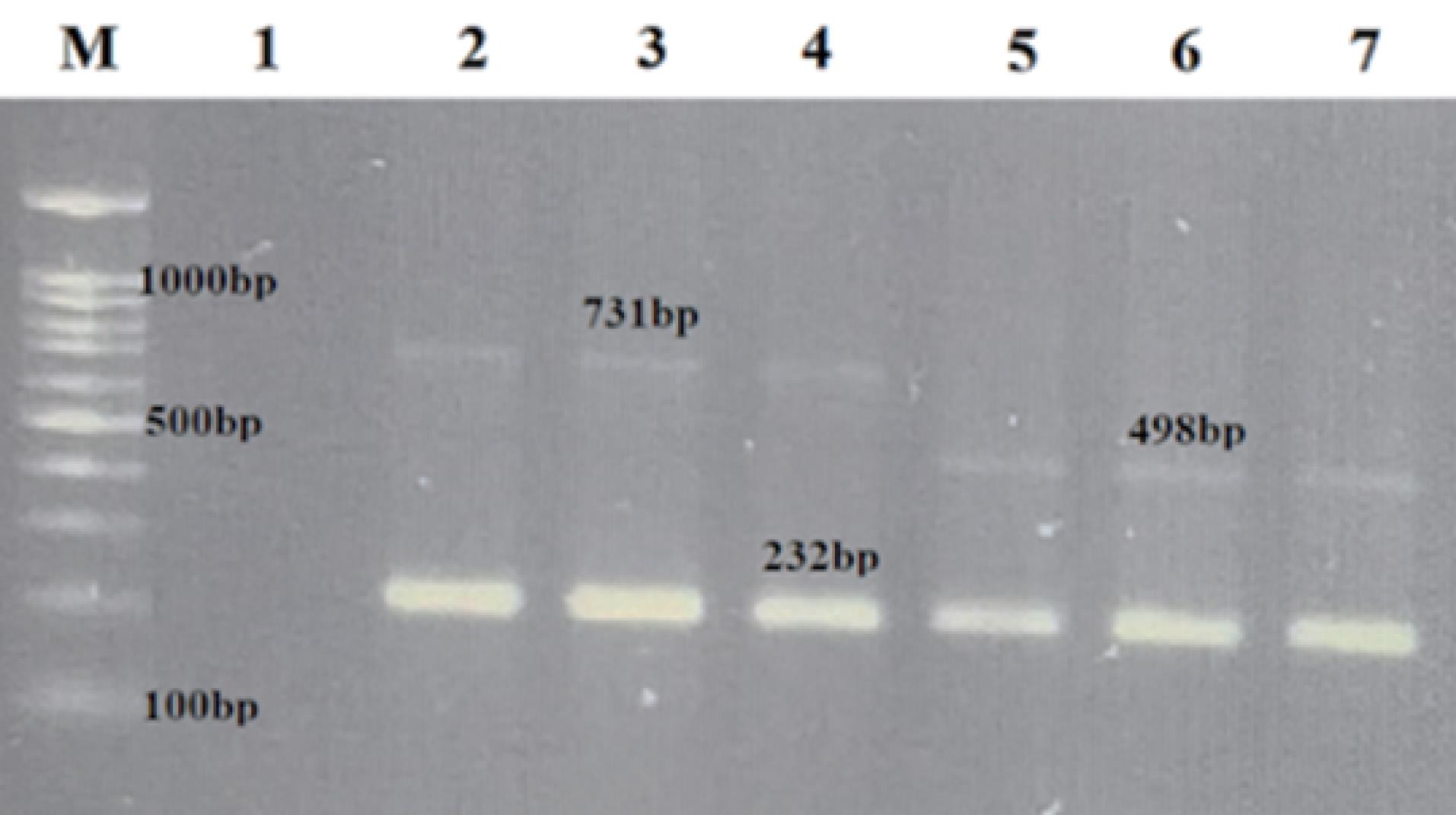
Figure 1.
Agarose Gel Electrophoresis of PCR Products for the Detection of B. melitensis and B. abortus Using Multiplex PCR for B4/B5 (232 bp), Bm-SP Is711 (731 bp), and Ba-SP Is711 (498 bp) Genes. Note. PCR: Polymerase chain reaction; B. melitensis: Brucella melitensis; B. abortus: Brucella abortus; E. coli: Escherichia coli. M: 1000 bp DNA marker. Well 1: Negative control E. coli; well 2: Positive control B. melitensis M16 (ATCC: 23456); wells 3 and 4: B. melitensis isolates; well 5: Standard strain B. abortus 544 (ATCC: 23448); wells 6 and 7: B. abortus isolates
.
Agarose Gel Electrophoresis of PCR Products for the Detection of B. melitensis and B. abortus Using Multiplex PCR for B4/B5 (232 bp), Bm-SP Is711 (731 bp), and Ba-SP Is711 (498 bp) Genes. Note. PCR: Polymerase chain reaction; B. melitensis: Brucella melitensis; B. abortus: Brucella abortus; E. coli: Escherichia coli. M: 1000 bp DNA marker. Well 1: Negative control E. coli; well 2: Positive control B. melitensis M16 (ATCC: 23456); wells 3 and 4: B. melitensis isolates; well 5: Standard strain B. abortus 544 (ATCC: 23448); wells 6 and 7: B. abortus isolates
The molecular results obtained through multiplex PCR (Figure 2) confirmed the biochemical identification of Brucella isolates. Subsequently, the study examined the presence of key Brucella virulence factor genes, including znuA, bvfA, omp25, omp31, and mviN. The electrophoretic bands observed for these genes were 465 bp (znuA),1282 bp (bvfA),188 bp (omp25),257 bp (omp31), and 364 bp (mviN).
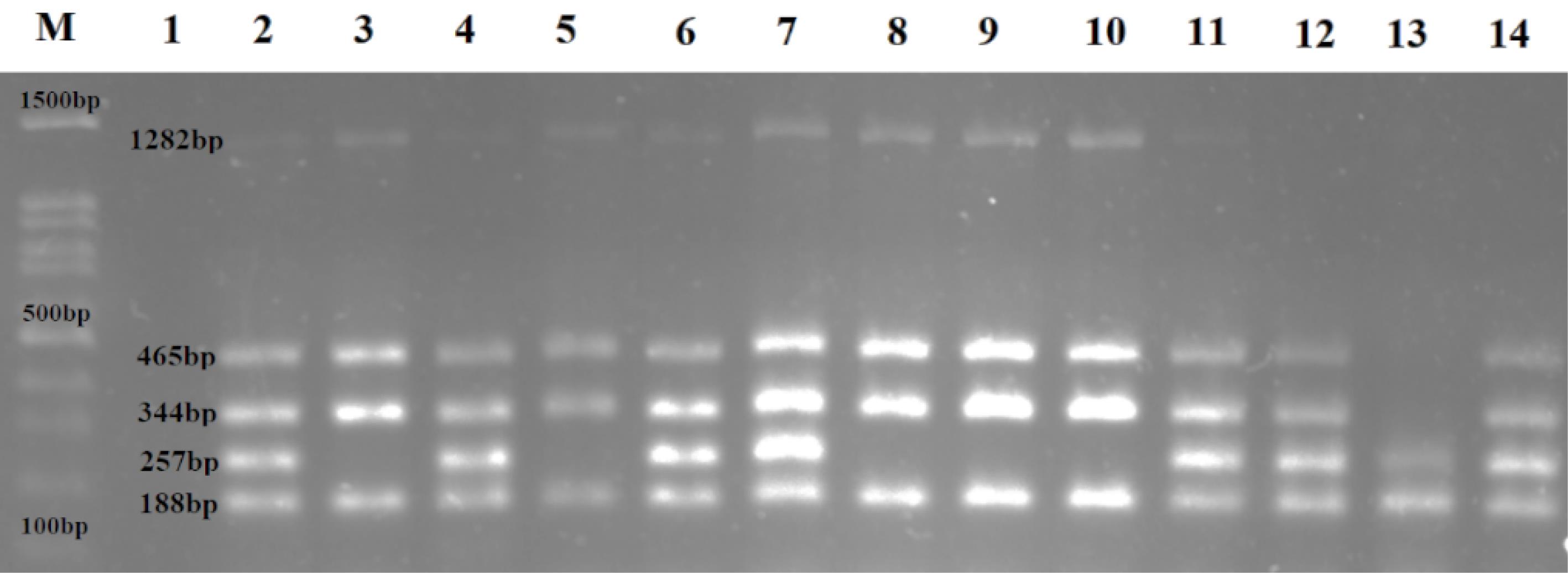
Figure 2.
Gel Electrophoresis of Products from Multiplex PCR for the Detection of Virulence Factor-Encoding Genes, Including mviN (344 bp), omp25 (188 bp), omp31 (257 bp), znuA (465 bp), and bvfA (1282 bp), of Brucella Species. Note. PCR: Polymerase chain reaction; E. coli: Escherichia coli; B. abortus: Brucella abortus. M: 1000 bp DNA marker. Well 1: E. coli negative control; well 2: B. melitensis M16 standard strain (ATCC: 23456); wells 3-5: B. melitensis isolates of human origin. Wells 6 and 7: B. melitensis isolates of animal origin; well 8: B. abortus 544 standard strain (ATCC: 23448); wells 9-11: B. abortus isolates of human origin; wells 12-14: B. abortus isolates of animal origin
.
Gel Electrophoresis of Products from Multiplex PCR for the Detection of Virulence Factor-Encoding Genes, Including mviN (344 bp), omp25 (188 bp), omp31 (257 bp), znuA (465 bp), and bvfA (1282 bp), of Brucella Species. Note. PCR: Polymerase chain reaction; E. coli: Escherichia coli; B. abortus: Brucella abortus. M: 1000 bp DNA marker. Well 1: E. coli negative control; well 2: B. melitensis M16 standard strain (ATCC: 23456); wells 3-5: B. melitensis isolates of human origin. Wells 6 and 7: B. melitensis isolates of animal origin; well 8: B. abortus 544 standard strain (ATCC: 23448); wells 9-11: B. abortus isolates of human origin; wells 12-14: B. abortus isolates of animal origin
Out of the total 61 isolates analyzed, the frequency of each virulence gene in general was86.78% (znuA and bvfA), 88.52% (omp25), 81.96% (omp31), and100% (mviN). Table 3 compares the frequency of Brucella virulence genes in human and animal isolates. The study analyzed a total of 61 Brucella strains isolated from human and animal samples. Among the human isolates, 36 were obtained from patients aged 21–76 years (7 women and 29 men). Of these human isolates, 30 (83.33%) were identified as B. melitensis, and 6 (16.6%) were detected as B. abortus. The animal isolates included 25 samples from cattle, sheep, and goats, with 20 (80%) identified as B. melitensis and 5 (20%) as B. abortus.
Table 3.
Frequency of Brucella Virulence Factor Genes in Clinical and Animal Isolates
|
Virulence Genes
|
Total
N=61 (%)
|
Human Isolates
n=36 (%)
|
Animal isolates
n=25 (%)
|
|
znuA |
53/61 (86.88) |
32/36 (88.8) |
21/25 (84) |
|
bvfA |
53/61 (86.88) |
30/36 (83.3) |
23/25 (92) |
|
omp25 |
54/61 (88.52) |
31/36 (86.1) |
23/25 (92) |
|
omp31 |
50/61 (81.96) |
29/36 (80.5) |
21/25 (84) |
|
mviN |
61/61 (100) |
36/36 (100) |
25/25 (100) |
The demographic and clinical data, along with molecular test results, were statistically analyzed using SPSS software (version 19.8). The patient population demonstrated that 77.8% were males, and 22.2% females. The majority of patients (80.6%) resided in rural areas, while 19.4% were from urban settings. Regarding literacy levels, 47.2% were illiterate, 30.6% had primary education, and 22.2% held bachelor’s or master’s degrees. In terms of occupation, 25%, 30.6%, 13.9%, 22.2%, and 8.3% were housewives, livestock farmers, butchers, farmers and builders, and drivers/unemployed, respectively.
Regarding underlying health conditions, 72.2% had no underlying disease, while others suffered from type 2 diabetes (16.7%), chronic hypertension (5.6%), polycystic kidney disease (2.8%), and asthma (1%). The patients exhibited various clinical symptoms, including back pain (100%), headache (41.7%), fatigue (27.8%), pelvic pain (83.3%), sweating (36.1%), weakness (100%), muscle pain (25%), decreased appetite (80.6%), and joint pain (100%). In the livestock samples, a total of 25 samples were collected, including 80% cattle, 12% sheep, and 8% goats. All animals were female. The samples included lymph nodes (72%), amniotic fluid (8%), milk (8%), and mammary fluid (12%), respectively.
Discussion
Brucellosis continues to pose substantial public health and economic challenges, particularly in endemic regions, including Iran (30). This study molecularly identified Brucella species and evaluated the prevalence of virulence genes in Hamadan Province, an area recognized for its high incidence of brucellosis (31). Using multiplex PCR, valued for its high sensitivity, specificity, rapidity, and ability to detect Brucella spp. in diverse hosts (32), the research accurately identified species and virulence factors. The efficiency of this method is particularly useful in mixed livestock farms where cattle, sheep, and goats cohabitate, posing a risk for cross-species contamination (33).
The prevalence of Brucella in Iran varies from region to region, with seropositivity being influenced by regional endemicity and cattle management practices.
In a meta-analytical study in which brucellosis in Iranian animals was tested until 2022, all seropositivity rates for brucellosis were 3%, 4%, and 5% for cows, sheep, and goats (serum in the pool = 3%). The best environmental factors associated with seropositivity was in western Azerbaijan, northwest of Iran (34).
In a current cohort study by Adabi et al, seropositive tests for brucellosis have been performed in urban residents in Hamadan Province, and Brucella species have been identified using molecular methods. Their results revealed that 23 Brucella sero positive samples (sheep = 21 and goat = 2) tested on 1,660 animals were utilized to demonstrate Brucella DNA using BCSP31 target genes and the IS711 locus. Using certain primers, 20 out of the 23 rehearsals tested positive for Brucella infection. In addition, B. Melitensis and B. abortus were confirmed in 90% (n = 18) and 10% (n = 2) positive samples (35).
Another recent cohort study conducted by Adabi et al examined the seroprevalence of brucellosis among residents of Famenin, Hamedan. The study re-evaluated seropositive and some seronegative individuals from an initial 2016 survey, using Wright serological tests and PCR assays. The results showed that among 575 tested cases, 145 had elevated Wright titers, and PCR confirmed Brucella DNA in 63 samples. Further testing identified both B. abortus and B. melitensis in the population, indicating active infections with multiple Brucella species. These findings highlight ongoing zoonotic transmission in the region and point to the necessity of targeted public health measures (36).
Our results confirmed that B. melitensis was the most frequent species of human and animal samples, aligning with previous findings implicating B. melitensis as a major cause of human brucellosis in Iran (37). B. abortus was the second most common, emphasizing its role in the transmission of the disease from animals to humans. The detection of these species across different hosts suggests cross-transmission, consistent with the findings of Akoko et al in Kenya (1).
Based on the findings of a study performed by Karami et al on the horse population in Iran, there was no clear connection between the number of brucellosis cases and factors like gender, age, or the type of tested samples. This was attributed to the limited host range and small number of positive samples (38), which contradicts the findings of our study, which also faced similar limitations.
Likewise, Mengele et al evaluated circulating Brucella species among dairy cattle in Tanzania and reported that 66.2% of the identified species were B. melitensis (39), which conforms to our results.
Additionally, Alirezaei et al studied aborted small ruminants and identified B. ovis, B. melitensis, and B. abortus (40). Notably, B. ovis was not detected in our study, but the rest of their findings are consistent with ours.
This study investigated key virulence factor genes (i.e., znuA, bvfA, omp25, omp31, and mviN) in Brucella isolates, as these genes are crucial for bacterial pathogenicity and survival within hosts. Identifying these factors can aid in developing new vaccines and therapies against brucellosis (41). The results showed high frequencies of these genes across all isolates: 86.78% (znuA and bvfA), 88.52% (omp25), 81.96% (omp31), and 100% (mviN), highlighting their importance in Brucella pathogenicity. The ≥ 80% prevalence of these genes suggests that Brucella heavily relies on these virulence factors for infection.
These findings are closely in line with those of a 2021 Egyptian study performed by Fathy et al, which reported over 80% prevalence of omp25, omp31, bvfa, ure, znuA, and cbg genes in Brucella isolates from domestic animals and humans, emphasizing the necessity of comprehensive virulence factor expression in Brucella’s pathogenicity (19).
In contrast, Naseri et al, focusing on human brucellosis in Hamadan, found that all 57 isolates were B. melitensis, with bvfA being the most frequent gene at 93%. In our study, both B. melitensis and B. abortus were identified among humans, and mviN had the highest occurrence at 100%. The bvfA gene was present at 78.8% in humans and 92% in animals. Differences in virulence gene prevalence may be attributed to several factors, such as geographic location, circulating Brucella species, host type, climate changes, and livestock vaccination practices (25).
Conclusion
The findings of this research confirmed that brucellosis remains a major problem for both public health and animal care in Hamadan province, necessitating comprehensive control measures. Thus, accurate identification of Brucella species and their virulence factors is crucial for guiding effective prevention and treatment strategies. Furthermore, implementing rapid diagnostic techniques (e.g., multiplex PCR) can help reduce the disease prevalence and associated complications within the community, thereby enhancing overall brucellosis control efforts. The molecular analysis also revealed that both B. melitensis and B. abortus are actively spreading among various animal and human hosts in the region.
Acknowledgements
We sincerely thank the microbiology laboratory staff of Sina Hospital, the Core Laboratory staff of Hamadan University of Medical Sciences, and the laboratory staff of the Microbiology Department at the Faculty of Medicine of Hamadan University of Medical Sciences, for their invaluable support and assistance.
Competing Interests
The authors declare no competing interests.
Ethical Approval
The present study was approved by the Ethics Committee of Shahrekord University, Shahrekord, Iran (IR.SKU.REC.1404. 007).
Funding
This research was supported by Shahrekord University, Shahrekord, Iran (Grant No. 170.1408).
References
- Akoko JM, Pelle R, Lukambagire AS, Machuka EM, Nthiwa D, Mathew C. Molecular epidemiology of Brucella species in mixed livestock-human ecosystems in Kenya. Sci Rep 2021; 11(1):8881. doi: 10.1038/s41598-021-88327-z [Crossref] [ Google Scholar]
- Pappas G, Papadimitriou P, Akritidis N, Christou L, Tsianos EV. The new global map of human brucellosis. Lancet Infect Dis 2006; 6(2):91-9. doi: 10.1016/s1473-3099(06)70382-6 [Crossref] [ Google Scholar]
- Yumuk Z, O’Callaghan D. Brucellosis in Turkey--an overview. Int J Infect Dis 2012; 16(4):e228-35. doi: 10.1016/j.ijid.2011.12.011 [Crossref] [ Google Scholar]
- Lopes LB, Nicolino R, Haddad JP. Brucellosis-risk factors and prevalence: a review. Open Vet Sci J 2010; 4(1):72-84. doi: 10.2174/1874318801004010072 [Crossref] [ Google Scholar]
- Dean AS, Crump L, Greter H, Schelling E, Zinsstag J. Global burden of human brucellosis: a systematic review of disease frequency. PLoS Negl Trop Dis 2012; 6(10):e1865. doi: 10.1371/journal.pntd.0001865 [Crossref] [ Google Scholar]
- Mirnejad R, Mohammadi M, Majdi A, Taghizoghi N, Piranfar V. Molecular typing of Brucella melitensis and B abortus from human blood samples using PCR-RFLP method. Jundishapur J Microbiol 2013; 6(6):e7197. doi: 10.5812/jjm.7197 [Crossref] [ Google Scholar]
- Golshani M, Buozari S. A review of brucellosis in Iran: epidemiology, risk factors, diagnosis, control, and prevention. Iran Biomed J 2017; 21(6):349-59. doi: 10.18869/acadpub.ibj.21.6.349 [Crossref] [ Google Scholar]
- Boschiroli ML, Foulongne V, O’Callaghan D. Brucellosis: a worldwide zoonosis. Curr Opin Microbiol 2001; 4(1):58-64. doi: 10.1016/s1369-5274(00)00165-x [Crossref] [ Google Scholar]
- Aminzadeh Z, Farrokhi B, Akhavan Zanjani H, Aliyari F, Baiati Z, Navaei F. Screening of household members and contacts of patients with acute brucellosis to detect unrecognized cases. J Infect Dis Immun 2010; 2(3):41-3. [ Google Scholar]
- Kassiri H, Amani H, Lotfi M. Epidemiological, laboratory, diagnostic and public health aspects of human brucellosis in western Iran. Asian Pac J Trop Biomed 2013; 3(8):589-94. doi: 10.1016/s2221-1691(13)60121-5 [Crossref] [ Google Scholar]
- Mantur BG, Amarnath SK. Brucellosis in India - a review. J Biosci 2008; 33(4):539-47. doi: 10.1007/s12038-008-0072-1 [Crossref] [ Google Scholar]
- Díaz-Aparicio E, Marín C, Alonso-Urmeneta B, Aragón V, Pérez-Ortiz S, Pardo M. Evaluation of serological tests for diagnosis of Brucella melitensis infection of goats. J Clin Microbiol 1994; 32(5):1159-65. doi: 10.1128/jcm.32.5.1159-1165.1994 [Crossref] [ Google Scholar]
- Al Dahouk S, Nöckler K. Implications of laboratory diagnosis on brucellosis therapy. Expert Rev Anti Infect Ther 2011; 9(7):833-45. doi: 10.1586/eri.11.55 [Crossref] [ Google Scholar]
- Dadar M, Alamian S, Behrozikhah AM, Yazdani F, Kalantari A, Etemadi A. Molecular identification of Brucella species and biovars associated with animal and human infection in Iran. Vet Res Forum 2019; 10(4):315-21. doi: 10.30466/vrf.2018.89680.2171 [Crossref] [ Google Scholar]
- Doosti A, Ghasemi Dehkordi P. Application of real-time PCR for identification and differentiation of Brucella abortus and Brucella melitensis in cattle. Bulg J Vet Med 2011; 14(2):109-15. [ Google Scholar]
- Ocholi RA, Kwaga JKP, Ajogi I, Bale JO. Phenotypic characterization of Brucella strains isolated from livestock in Nigeria. Vet Microbiol 2004; 103(1-2):47-53. doi: 10.1016/j.vetmic.2004.06.012 [Crossref] [ Google Scholar]
- O’Leary S, Sheahan M, Sweeney T. Brucella abortus detection by PCR assay in blood, milk and lymph tissue of serologically positive cows. Res Vet Sci 2006; 81(2):170-6. doi: 10.1016/j.rvsc.2005.12.001 [Crossref] [ Google Scholar]
- Pishva E, Salehi M. First report of isolation of Brucella melitensis, vaccine strain Rev 1 as a source of cattle infection in Iran. J Sci Islam Repub Iran 2008; 19(1):19-23. [ Google Scholar]
- Fathy S, Hamdy ME, Osman KM. Incidence of virulence genes in predominant Brucella strains among domestic animals in Egypt. Bulg J Vet Med 2023; 26(2):182-201. doi: 10.15547/bjvm.2021-0033 [Crossref] [ Google Scholar]
- Lavigne JP, Patey G, Sangari FJ, Bourg G, Ramuz M, O’Callaghan D. Identification of a new virulence factor, BvfA, in Brucella suis. Infect Immun 2005; 73(9):5524-9. doi: 10.1128/iai.73.9.5524-5529.2005 [Crossref] [ Google Scholar]
- Edmonds MD, Cloeckaert A, Elzer PH. Brucella species lacking the major outer membrane protein Omp25 are attenuated in mice and protect against Brucella melitensis and Brucella ovis. Vet Microbiol 2002; 88(3):205-21. doi: 10.1016/s0378-1135(02)00110-4 [Crossref] [ Google Scholar]
- Delpino MV, Cassataro J, Fossati CA, Goldbaum FA, Baldi PC. Brucella outer membrane protein Omp31 is a haemin-binding protein. Microbes Infect 2006; 8(5):1203-8. doi: 10.1016/j.micinf.2005.11.008 [Crossref] [ Google Scholar]
- Kim S, Watanabe K, Shirahata T, Watarai M. Zinc uptake system (znuA locus) of Brucella abortus is essential for intracellular survival and virulence in mice. J Vet Med Sci 2004; 66(9):1059-63. doi: 10.1292/jvms.66.1059 [Crossref] [ Google Scholar]
- Briones G, Iñón de Iannino N, Roset M, Vigliocco A, Paulo PS, Ugalde RA. Brucella abortus cyclic beta-1,2-glucan mutants have reduced virulence in mice and are defective in intracellular replication in HeLa cells. Infect Immun 2001; 69(7):4528-35. doi: 10.1128/iai.69.7.4528-4535.2001 [Crossref] [ Google Scholar]
- Naseri Z, Alikhani MY, Hashemi SH, Kamarehei F, Arabestani MR. Prevalence of the most common virulence-associated genes among Brucella melitensis isolates from human blood cultures in Hamadan province, west of Iran. Iran J Med Sci 2016; 41(5):422-9. [ Google Scholar]
- Baily GG, Krahn JB, Drasar BS, Stoker NG. Detection of Brucella melitensis and Brucella abortus by DNA amplification. J Trop Med Hyg 1992; 95(4):271-5. [ Google Scholar]
- Bricker BJ, Halling SM. Differentiation of Brucella abortus bv 1, 2, and 4, Brucella melitensis, Brucella ovis, and Brucella suis bv 1 by PCR. J Clin Microbiol 1994; 32(11):2660-6. doi: 10.1128/jcm.32.11.2660-2666.1994 [Crossref] [ Google Scholar]
- Khosravi AD, Abassi E, Alavi SM. Isolation of Brucella melitensis and Brucella abortus from brucellosis patients by conventional culture method and polymerase chain reaction technique. Pak J Med Sci 2006; 22(4):396-400. [ Google Scholar]
- Hajia M, Fallah F, Angoti G, Karimi A, Rahbar M, Gachkar L. Comparison of methods for diagnosing brucellosis. Lab Med 2013; 44(1):29-33. doi: 10.1309/lm4j9mwobipa6rbn [Crossref] [ Google Scholar]
- Bagheri Nejad R, Krecek RC, Khalaf OH, Hailat N, Arenas-Gamboa AM. Brucellosis in the Middle East: current situation and a pathway forward. PLoS Negl Trop Dis 2020; 14(5):e0008071. doi: 10.1371/journal.pntd.0008071 [Crossref] [ Google Scholar]
- Shirzadi MR, Mohammadi P, Moradi G, Goodarzi E, Khazaei S, Moayed L. The incidence and geographical distribution of brucellosis in Iran using geographic information system and prediction of its incidence in 2021. J Prev Med Hyg 2021; 62(3):E635-4. doi: 10.15167/2421-4248/jpmh2021.62.3.1699 [Crossref] [ Google Scholar]
- Mohammad Hasani S, Mirnejad R, Amani J, Vafadar MJ. Comparing rapid and specific detection of Brucella in clinical samples by PCR-ELISA and multiplex-PCR method. Iran J Pathol 2016; 11(2):144-50. [ Google Scholar]
- Hamdy ME, Amin AS. Detection of Brucella species in the milk of infected cattle, sheep, goats and camels by PCR. Vet J 2002; 163(3):299-305. doi: 10.1053/tvjl.2001.0681 [Crossref] [ Google Scholar]
- Adabi M, Gharekhani J, Saadatmand A, Shahbazi F. Seroprevalence of brucellosis in livestock in Iran: a meta-analysis. Comp Clin Path 2024; 33(1):175-82. doi: 10.1007/s00580-023-03543-5 [Crossref] [ Google Scholar]
- Adabi M, Alamian S, Varasteh-Shams M, Ghaderi H, Shahbazi F, Gharekhani J. Molecular investigation of Brucella species belongs to sheep and goats in seropositive samples from an endemic area of Hamedan province; Famenin brucellosis cohort study. Arch Razi Inst 2023; 78(4):1349-57. doi: 10.32592/ari.2023.78.4.1349 [Crossref] [ Google Scholar]
- Adabi M, Karami M, Keramat F, Alikhani MY, Bakhtiari S. Serological and molecular investigation of human brucellosis in participants of Famenin brucellosis cohort study, Hamadan, Iran. Iran J Microbiol 2021; 13(3):319-24. doi: 10.18502/ijm.v13i3.6394 [Crossref] [ Google Scholar]
- Dadar M, Alamian S, Zowghi E. Comprehensive study on human brucellosis seroprevalence and Brucella species distribution in Iran (1970-2023). Microb Pathog 2025; 198:107137. doi: 10.1016/j.micpath.2024.107137 [Crossref] [ Google Scholar]
- Karami Y, Mohammadi E, Golchin M. Serological and molecular detection of Brucella spp infection in the equine population of Kerman, Iran. J Zoonotic Dis 2025; 9(3):887-94. doi: 10.22034/jzd.2025.64392.1329 [Crossref] [ Google Scholar]
- Mengele IJ, Akoko JM, Shirima GM, Bwatota SF, Motto SK, Hernandez-Castro LE. Brucella species circulating in smallholder dairy cattle in Tanzania. Pathogens 2024; 13(9):815. doi: 10.3390/pathogens13090815 [Crossref] [ Google Scholar]
- Alirezaei A, Khalili M, Baseri N, Esmaeili S, Mohammadi Damaneh E, Kazeminia S. Molecular detection of Brucella species among aborted small ruminants in southeast Iran. Braz J Microbiol 2024; 55(1):911-7. doi: 10.1007/s42770-023-01191-z [Crossref] [ Google Scholar]
- Ramadan ES, Mousa WS, Gafer JA, Elbaz HT, Abdeen E, Hussien H. Substantial virulence genes among Brucella melitensis field strains isolated from cattle in Egypt. Pak J Biol Sci 2019; 22(5):239-46. doi: 10.3923/pjbs.2019.239.246 [Crossref] [ Google Scholar]